
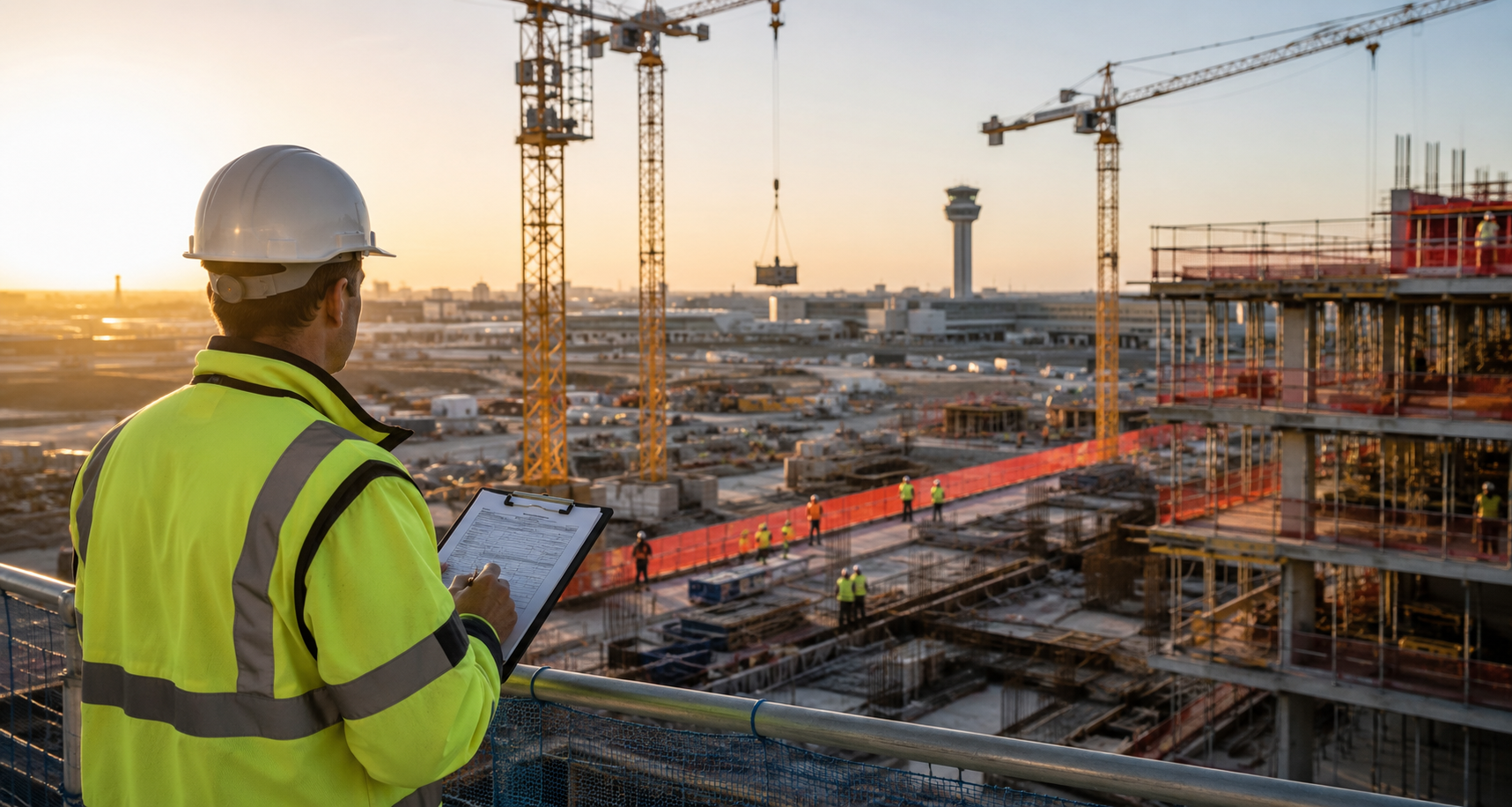
Health and Safety is one of the few construction disciplines that touches every project, in every sector, at every stage. For a Health and Safety Advisor in Ireland, that means the fundamentals stay constant while the day to day changes completely depending on the site. In 2026, experienced advisors are in demand across a strikingly broad range of projects, from aviation and high-rise residential to civils, utilities and education, and that variety is one of the things that makes the career so resilient.
One discipline, every kind of site
The core of the role does not change: keep people safe, keep the site compliant, and build a culture where issues are raised early. What changes is the risk profile. Moving from one project type to another can feel like a different job entirely, which is part of what makes a Health and Safety career in construction so varied. The professionals who thrive learn to read a new environment quickly, understand its specific hazards, and adapt their focus without ever losing sight of the fundamentals that apply everywhere.
Why demand is broad in 2026
Demand for Health and Safety Advisors in Ireland is broad right now because the pipeline itself is broad. With aviation, residential, civils, utilities and education projects all active at once, contractors need advisors who can step into very different environments and be effective quickly. That range of live work is good news for advisors, because it means genuine choice about the kind of projects they take on and the direction their career takes next, rather than being locked into a single sector.
Health and safety on aviation projects
Aviation work brings a layer that most sites never face: live operational environments and airside rules. An advisor here is managing construction risk while working around active infrastructure, tight access controls and standards set by the operator. Coordination with the wider site and the operator is constant, and the tolerance for error is very low. It is demanding, specialist work, and experience on this kind of project is highly valued precisely because relatively few advisors have built it.
Health and safety on high-rise residential
On a high-rise residential build in Dublin, the risk moves upward, literally. Working at height, lifting operations and a dense, fast moving programme dominate the picture. The advisor is balancing a demanding schedule against the reality that the most serious risks on the site are also the ones under the most time pressure. Strong planning, a visible presence on the floors and a good relationship with the trades make the difference between a safe programme and a stressful one.
Health and safety on civils and utilities
Civils and utilities work spreads the challenge out. Excavations, groundworks, heavy plant and constant public interface define the risk, often across several sites at once. Underground services, traffic management and the public all add complexity that an office based approach cannot cover. An advisor covering this kind of work needs to be mobile, practical and comfortable making decisions in the field. It suits people who like variety and want to stay close to the physical work.
Health and safety on education projects
Education projects add a human dimension. You are often building around occupied or soon to be occupied spaces, which brings safeguarding and public safety into the frame alongside the usual construction hazards. Coordinating a live build with the rhythm of a school or campus takes a careful, communicative advisor who can hold both priorities at once, and who can plan works around the people using the space rather than despite them.
Qualifications and what sets advisors apart
The right qualifications open the door, and continuing to build them matters, but they are rarely what sets an advisor apart. Employers look for people who can influence without authority, who are respected on site rather than resented, and who make safety feel like part of the job rather than an interruption to it. The advisors who progress are the ones who can move between very different project types and quickly earn the trust of a new team, because that adaptability is genuinely hard to find and even harder to replace.
What makes a strong Health and Safety Advisor
Across all of these, the best advisors share something. They are not seen as a brake on the build. They keep it moving by catching issues while they are still cheap to fix, and they are credible enough with the trades that problems are brought to them early rather than hidden. They combine firmness on the things that genuinely matter with a practical sense of how work actually gets done. If you are looking for your next Health and Safety role in Ireland, or building a safety team, our specialists at Necto Selection can help you find the right fit.